
Assessing the condition of marine assets is the next step in the natural capital workflow. Habitat condition reflects how well a habitat is functioning relative to expectations for its structure, processes and resilience.
Marine management is increasingly taking an ecosystem-wide approach. This requires a more detailed understanding of ecosystem services and how they are delivered, alongside the inclusion of social and economic factors (Börger et al., 2014). An understanding of how the condition (health) of environmental assets (habitats, species) and processes mediates their delivery of ecosystem services is integral to natural capital-based approaches to management and decision-making (Grizzetti et al., 2019; Tillin, 2023).
Condition can include biological metrics (e.g., population size), abiotic metrics (e.g., temperature), and measures of the impacts of stressors (e.g., physical damage). Biological condition indicators are measured over time and compared to agreed targets to provide an assessment of ‘status’ (Tillin, 2023).
For this workflow we can use the MESO tool, which applies a Bayesian Belief Network model to estimate how combinations of pressures affect seabed habitats, ecological functions and ultimately the services they support.
Marine Natural Capital Hub: Workflow




What is Asset Condition?
Within our natural capital approach, ecological condition describes how well a marine habitat or species is functioning relative to what would be expected under natural or minimally disturbed conditions. Condition reflects the integrity of the asset, including its structure, species composition, ecological processes and resilience.
Changes in condition occur in response to pressures, which are human‑driven or natural factors that alter the structure or functioning of marine assets. Pressures may include physical disturbance such as abrasion (e.g. from fishing), extraction or smothering; chemical stressors such as contamination or nutrient enrichment; environmental changes such as increased turbidity or temperature shifts; and biological pressures such as the introduction of non‑native species. These pressures disrupt ecological processes, reduce habitat quality or limit the performance of key species and functional groups. Understanding pressures is therefore essential for interpreting why condition changes.
Why is Asset Condition Important?
Understanding the condition of marine habitats and the pressures acting upon them is critical because it determines whether natural capital assets can continue to support ecosystem functions and deliver services. Where habitats are in good ecological condition, the ecosystem functions that underpin service delivery are generally considered more robust. Conversely, when condition declines, the capacity of an asset to generate benefits such as carbon sequestration, nutrient cycling, water quality regulation or nursery habitat provision is reduced.
Condition also plays a central role in resilience. Habitats in good ecological condition are better able to absorb disturbance, recover from impacts and maintain functioning under changing environmental conditions. Structural complexity, healthy species assemblages and stable physical characteristics all contribute to resilience by supporting ecological processes that allow systems to adapt and persist.
In the context of natural capital, maintaining or improving condition is essential for sustainability. Sustainable delivery of ecosystem services depends on ecosystems remaining functional over time. When pressures such as abrasion, siltation, extraction, contamination or altered hydrodynamics degrade condition, the long-term availability of services becomes less certain. Understanding how pressures influence condition allows managers to identify where intervention, mitigation or restoration is necessary to safeguard future service provision.
By linking pressures to condition, and condition to ecosystem service delivery, we can build a transparent understanding of how human activities affect the flow of benefits from marine ecosystems. This supports evidence-based management, helps prioritise areas for recovery and ensures that natural capital is maintained for long-term societal wellbeing.
How is Asset Condition Measured?
There are multiple ways to assess condition in marine systems, including sensitivity assessments, pressure mapping, model‑based approaches as well as marine condition indicators (such as UK Marine Strategy Indicators). Each provides different insights into how human activities may influence a habitat’s ability to support ecosystem services.
In the natural capital context we have focused on two areas at JNCC:
- MESO tool – see below section
- Linking spatial condition indicators to ecosystem service delivery. This has been achieved for the Extent of Physical Damage Indicator (mNCEA Year 2:Chapter 2) and the Physical Loss Indicators (mNCEA Year 3:Chapter 3).
Marine Ecosystem Services Optimisation Tool (MESO)
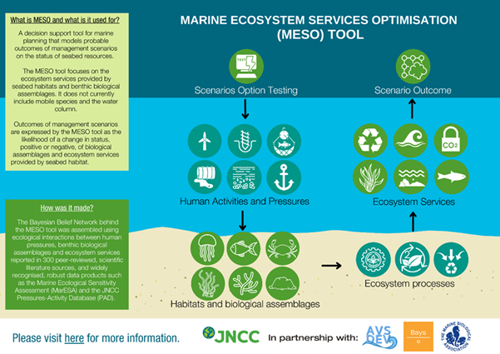
The MESO tool applies a Bayesian Belief Network model to estimate how combinations of pressures affect seabed habitats, ecological functions and ultimately the services they support. MESO builds on MarESA sensitivity evidence and models five broadscale sublittoral habitats.
By toggling pressures such as abrasion, extraction, turbidity change or contamination, users can explore how condition may shift under different scenarios.
MESO provides a practical way to link pressures to ecological change and to understand how habitat condition influences ecosystem service provision within the natural capital workflow.
mNCEA Outputs
mNCEA Outputs that are relevant to condition of assets and services:
- mNCEA A Natural Capital Approach to Achieving Good Environmental Status mNCEA Year 2. Chapter 2: Ecosystem service mapping case studies and Chapter 5: Asset condition and service delivery relationships.
- mNCEA A Natural Capital Approach to Achieving Good Environmental Status mNCEA Year 3. Chapter 3: Integrating climate risks into our understanding of ecosystem service delivery.
- Summary of progress towards Good Environmental Status - Marine online assessment tool
See Marine Natural Capital Hub: mNCEA Outputs Library for full list of outputs.
References
Börger, T., Beaumont, N.J., Pendleton, L., Boyle, K.J., Cooper, P., Fletcher, S., Haab, T., Hanemann, M., Hooper, T.L., Hussain, S.S., Portela, R., Stithou, M., Stockill, J., Taylor, T., Austen, M.C., 2014. Incorporating ecosystem services in marine planning: The role of valuation. Mar. Policy 46, 161–170. https://doi.org/10.1016/j.marpol.2014.01.019
Grizzetti, B., Liquete, C., Pistocchi, A., Vigiak, O., Zulian, G., Bouraoui, F., De Roo, A., Cardoso, A.C., 2019. Relationship between ecological condition and ecosystem services in European rivers, lakes and coastal waters. Sci. Total Environ. 671, 452–465. https://doi.org/10.1016/j.scitotenv.2019.03.155
Tillin, H., 2023. Relationship between asset condition and ecosystem service delivery: Bridging the gap between the Foundational Evidence and GES projects. JNCC.
Categories:
Published: