
Official statistic on provisional Cormorant population indices
This page hosts the Official Statistic 'Provisional Cormorant population indices for England 2026', published on 23 July 2026.
Official Statistic description
- This release includes provisional indices of Cormorant population in England, showing change in population between 1987/88 and 2025/26. The statistic is based on data gathered through the BTO/RSPB/JNCC Wetland Bird Survey (WeBS), results from which are published annually in the Spring.
- Cormorant indices up to the year 2025/26 are being released early as provisional to enable their use for operational purposes before the main WeBS Official Statistic release in Spring 2027. These provisional indices are based on the vast majority of England Cormorant data that are expected to be included in the subsequent WeBS Official Statistic release, and are therefore expected to be a good indication of the final results.
- Technical details of the WeBS method are set out in a separate document available on the BTO website
- The Wetland Bird Survey (WeBS) is a partnership jointly funded by the British Trust for Ornithology (BTO), Royal Society for the Protection of Birds (RSPB) and JNCC, with fieldwork conducted by volunteers.
Scope of statistic
- This release covers Cormorant data from England only.
- The Statistic includes unsmoothed and smoothed annual population indices from 1987/88 to 2025/26.
- 25-year and 10-year trends are reported based on the smoothed indices.
Summary of results
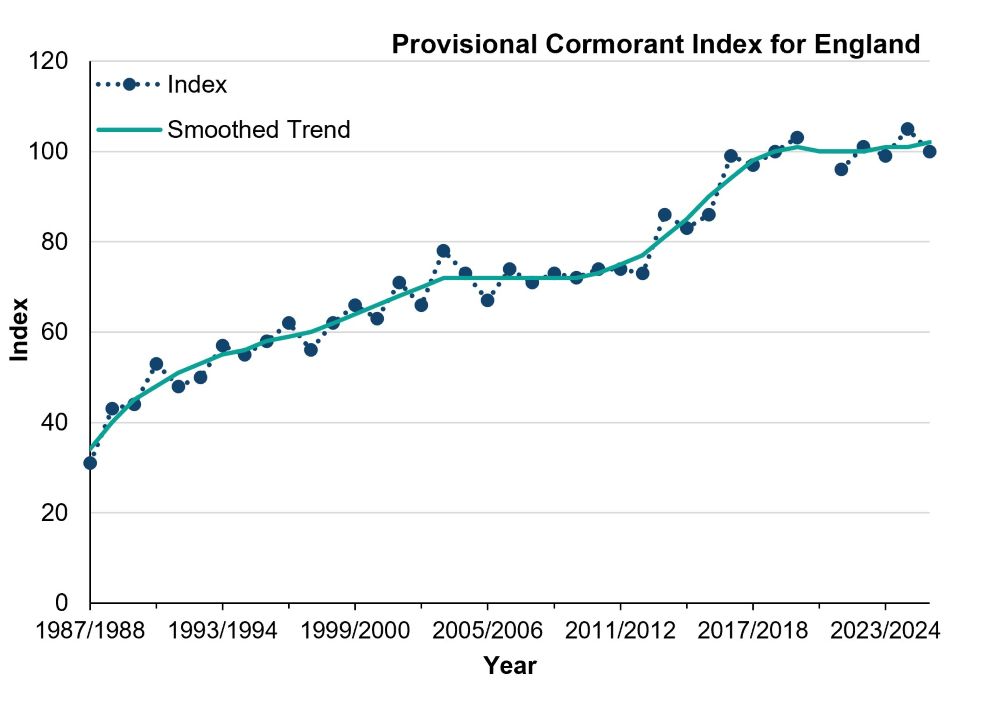
- The Cormorant population in England increased since monitoring began in 1987/88.
- However, population indices indicate a recent levelling off.
- The 25-year trend (based on smoothed indices 1999/2000 to 2024/25) shows an increase of 58%, and the 10-year trend (based on smoothed indices 2014/15 to 2024/25) shows a smaller increase of 19%.
- Note, for statistical reasons it is customary to truncate the final year when reporting smoothed trends, so whilst data from 2025/26 have been used in creating the smoothed index values, the trend period assessed and reported is until 2024/25.
- The data are provided in a spreadsheet and are available under Open Government Licence (attribution statement: Contains Wetland Bird Survey (WeBS) data © copyright and database right 2026. WeBS is a partnership jointly funded by the BTO, RSPB and JNCC with fieldwork conducted by volunteers).
Confidence in results and caveats
- WeBS volunteers follow standardised, peer-reviewed methods to ensure results are scientifically robust. The submitted data undergo a combination of automated and manual validation and verification processes.
- Trends are produced using Generalized Additive Models based on changes in smoothed population indices – this reduces the risk that short-term fluctuations obscure long-term trends. Missing values are accounted for using the Underhill indexing method (Underhill L.G. & Prys-Jones, R. 1994. Index numbers for waterbird populations. I. Review and methodology. Journal of Applied Ecology, 31, 463–480).
- The index value for 2020/21 is omitted due to being heavily impacted by reduced survey coverage during Covid-19 restrictions. Further detail is provided in Austin et al. 2023 Waterbirds in the UK 2021-22: The Wetland Bird Survey and Goose & Swan Monitoring Programme.
- Although the statistical significance of trends is not currently assessed, the statistical approaches used to generate and compare indices are routinely used in peer-reviewed publications.
- Data from the 2025/26 recording season used in these provisional indices amounted to 94% of the expected total number of sites (based on an average number of sites contributing over the past 5 years). Therefore, whilst some additional data are expected to be submitted, the indices for Cormorants in England are not expected to change much between July 2026 and Spring 2027.
- Further detail is provided in the spreadsheet of results.
Who was involved and key contact point
- This statistic was produced by BTO with Quality Assurance carried out by BTO and JNCC.
- The data are published as a JNCC Official Statistic. If you have any queries, please get in touch.
Relation to any other National/Official Statistics
- An updated version of these statistics will be included in the Spring 2027 Official Statistic release 'Population Trends for Waterbirds in the UK' (the Spring 2027 update will include data up to 2026).
- ‘Population Trends for Waterbirds in the UK’ feeds into the National Statistics Compendium UK Biodiversity Indicators, and country-level indicators (e.g. for Scotland and for England) and will feed into the Outcome Indicator Framework for the Environmental Improvement Plan in England.
- This statistic forms part of a suite of statistics produced through partnership monitoring schemes as part of JNCC’s terrestrial evidence programme.
Published: .