
Birds of the wider countryside and at sea
Last updated: 2025
Latest data available: 2024
Introduction
The indicator shows relative changes in the abundance of common native birds of farmland and woodland and of freshwater and marine habitats in the UK. Bird populations have long been considered to provide a good indication of the broad state of wildlife in the UK. This is because they occupy a wide range of habitats and respond to environmental pressures that also operate on other groups of wildlife. In addition, there are considerable long-term data on trends in bird populations, allowing for comparison between short-term and long-term changes. Because they are a well-studied taxonomic group, drivers of change for birds are better understood than for some other species groups, which enables interpretation of observed changes.
The relative changes in abundances of birds presented here form an indicator for the UK and an equivalent indicator for England is published separately. Both indicators are derived from the Wild bird populations in the UK and England, 1970 to 2024, an accredited official statistic published annually. The publication includes more detailed information, including a breakdown of sub habitat specific indices and individual species trends.
The statistical (bootstrapping) approach to generating confidence intervals used in indicators with a large and diverse suite of species can be sensitive to individual species with sparse data in periods of the time series. This year we reviewed individual species trends contributing towards the indicators and made improvements that have resulted in more robust confidence interval estimates and trends.
Data for this indicator can be found in the published datafile.
Type of indicator
State indicator
Type of official statistics
Accredited Official Statistics

Contents
- Assessment of change
-
Key results
- Figure 1: The indices of breeding and non-breeding bird populations by habitat in the United Kingdom, 1970 to 2024
- Figure 2: Trends in UK bird species across habitats: A comparison of long-term and short-term changes
- Farmland birds
- Figure 3: The index of breeding farmland bird populations for the United Kingdom, 1970 to 2024
- Woodland birds
- Figure 4: The index of breeding woodland bird populations for the United Kingdom, 1970 to 2024
- Water and wetland birds
- Figure 5: The index of breeding water and wetland bird populations for the United Kingdom, 1975 to 2024
- Seabirds
- Figure 6: The index of breeding seabird populations for the United Kingdom, 1986 to 2024
- Upland birds
- Figure 7: The index of breeding upland bird populations for the United Kingdom, 1994 to 2024
- Wintering waterbirds
- Figure 8: The index of breeding wintering waterbird populations for the United Kingdom, 1975/1976 to 2023/2024
- Further detail
- Acknowledgements
- Technical annex
- References
Assessment of change
| Measure | Time period | Long-term trend | Short-term trend |
|---|---|---|---|
| All bird species | 1970 to 2024 | Deteriorating | Deteriorating |
| Farmland | 1970 to 2024 | Deteriorating | Deteriorating |
| Seabirds | 1986 to 2024 | Deteriorating | Deteriorating |
| Upland | 1994 to 2024 | Deteriorating | Little or no overall change |
| Wetland | 1975 to 2024 | Little or no overall change | Deteriorating |
| Wintering waterbirds | 1975/1976 to 2023/2024 | Improving | Little or no overall change |
| Woodland | 1970 to 2024 | Deteriorating | Little or no overall change |
Notes on the indicator assessment
Long-term and short-term assessments of the statistical significance of these changes are made using the smoothed data to 2024. Analysis of the underlying trends is undertaken by the data providers. ‘Long-term’ refers to an assessment of change since the earliest date for which data are available; this varies among indicators and among individual species. ‘Short-term’ refers to an assessment of change over the latest five years for which data are available.
Key results
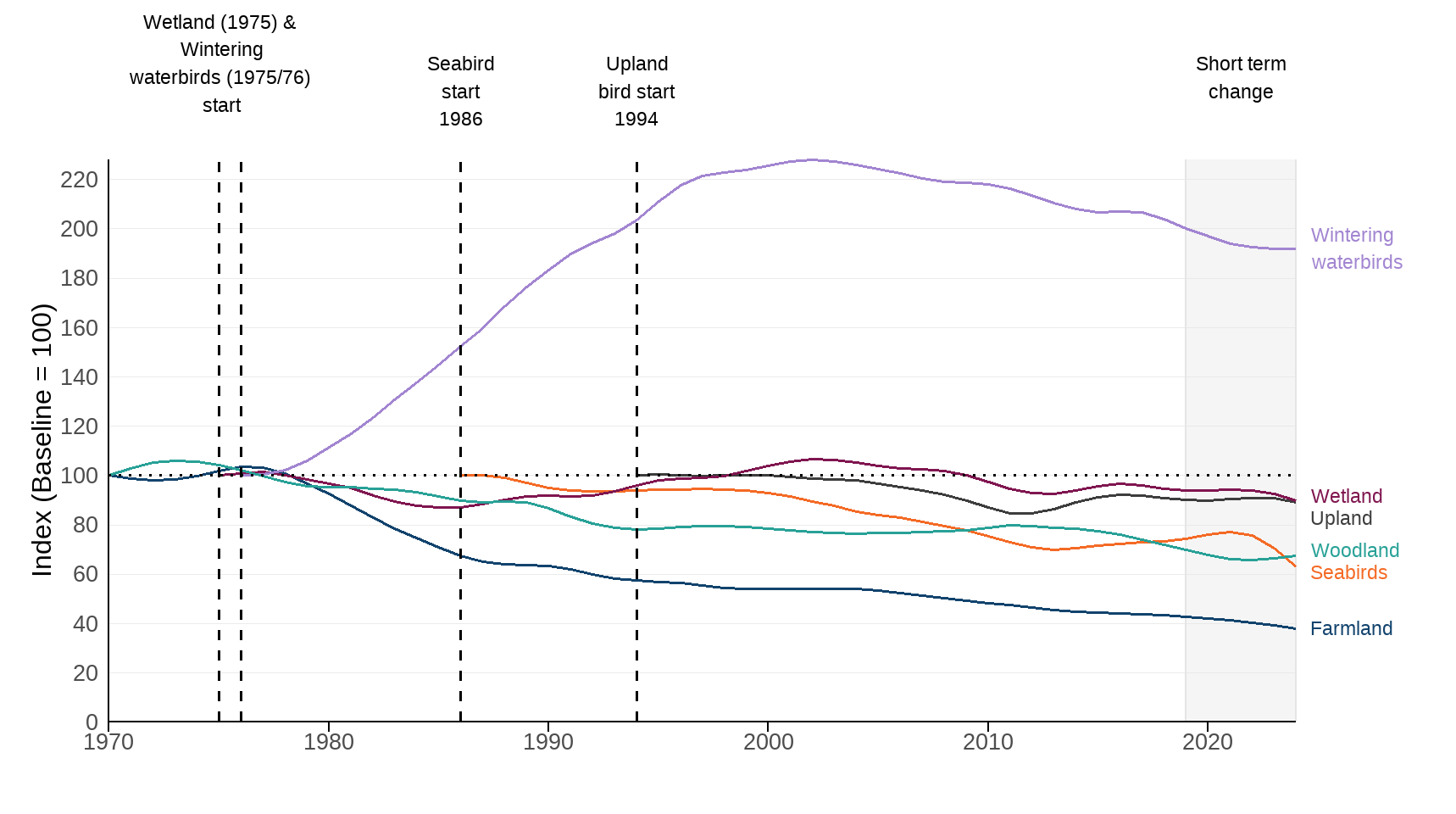
The indices for different habitat breakdowns are summarised in Figure 1. Each index is comprised of a different aggregation of species, specific to a given habitat. More detailed charts which include confidence intervals are presented for each habitat separately in Figures 3 to 8. A summary of the key results are given below:
- Breeding birds indices show long-term decline: Farmland birds (-62%), woodland birds (-32%), seabirds (-37%) and upland birds (-11%) indices all show various levels of decline.
- Farmland birds show greatest decline: Farmland bird populations have decreased by nearly two thirds since 1970 and 11% in the last five years.
- Woodland species beginning to stabilise: populations have declined substantially over the long term, but due to some recent years of high abundance in some parts of the UK, relatively little overall change in the short-term.
- Wintering water birds change trends: This index is made up of counts of over-wintering and not breeding birds. These wintering populations have increased markedly in the long term (92%), but this trajectory changed around 2000 and has since shown little or no overall change in the most recent five year period.
Figure 1: The indices of breeding and non-breeding bird populations by habitat in the United Kingdom, 1970 to 2024
Source: British Trust for Ornithology (BTO), Royal Society for the Protection of Birds (RSPB), and the Joint Nature Conservation Committee (JNCC)
Notes about Figure 1
- The indicators are based on the aggregated population trends for each habitat.
- Data for wintering waterbirds are collected over the winter which spans two years e.g. 1975/1976. These data are plotted here as a single year, taking the later part of the winter period e.g. 1975/1976 data is plotted at 1976 on the x axis.
- The wintering waterbirds index focuses on bird species that over-winter in the UK, some of which may also breed here. All other habitat breakdowns focus on breeding birds.
Individual species trends for different habitats in the UK
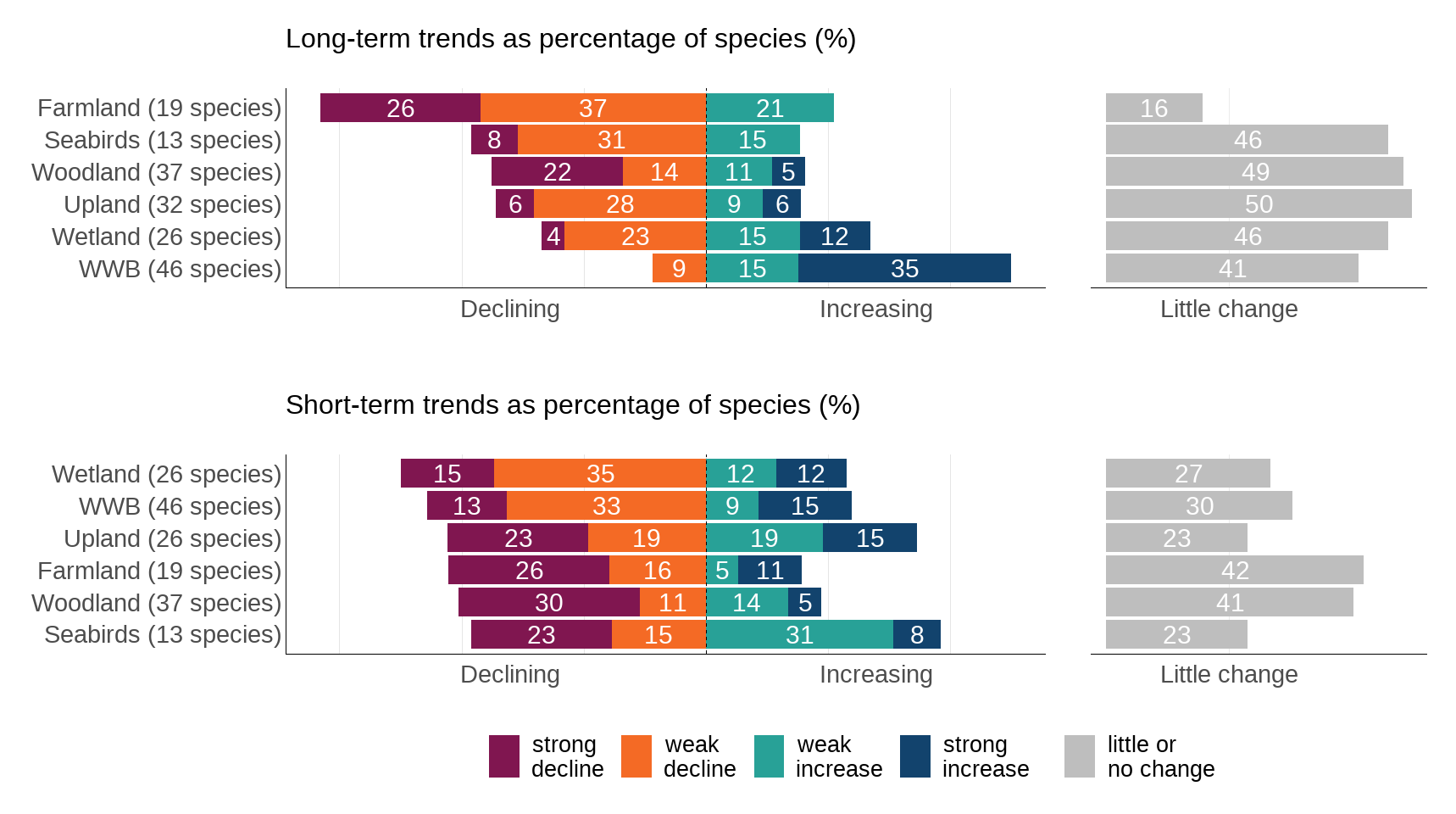
As discussed above, each habitat index is comprised of a different aggregation of species. The trends of each individual species within these habitats indices varies from some species being in strong decline to others showing little change, and others showing a strong increase over time. A summary of the variation in individual species trends observed within habitats is presented in Figure 2. A summary of the key results are given below:
-
Widespread species show declines across habitats: across all habitats, a significant percentage of species are in decline over the long term, except for breeding and wintering birds of UK wetlands, with farmland habitats showing the highest proportions of declining species. In contrast, the short-term declining trends are most prevalent in wetland and wintering waterbird species. Across most of the habitats, fewer species are increasing than declining.
-
Woodland species beginning to stabilise: woodland species were reported to have the highest number of species declining in the short term under our previous publication. This year, we see fewer species declining and more species increasing, although overall there are still more declining than increasing species.
-
Farmland species are still under pressure: farmland species are particularly at risk, with the highest percentage of species in decline across both time periods and relatively few species are increasing.
-
Stability in certain habitats: across several habitats, a notable proportion of species show little change over the long term, including wetland, woodland and upland, which includes nearly half of the species. In the short term woodland and farmland habitats show a substantial proportion of species with little change.
-
A reversal in trend for wintering waterbirds: over the long term, almost half of all wintering waterbird populations have increased, whereas the opposite trend is seen over the short term, with a similar proportion now in decline. This gradual downward trajectory started in the early 2000s.
Figure 2: Trends in UK bird species across habitats: A comparison of long-term and short-term changes
Source: British Trust for Ornithology (BTO), Royal Society for the Protection of Birds (RSPB), and the Joint Nature Conservation Committee (JNCC)
Notes about Figure 2
- Each bar represents 100% of the species within a habitat.
- Each bar within a row shows the percentage of species within the indicator that are categorised as showing an increase (strong or weak increase), a decrease (strong or weak decline) or little or no overall change.
- Habitats are ranked by highest percentage of species in decline.
- WWB: Wintering waterbirds.
Farmland birds
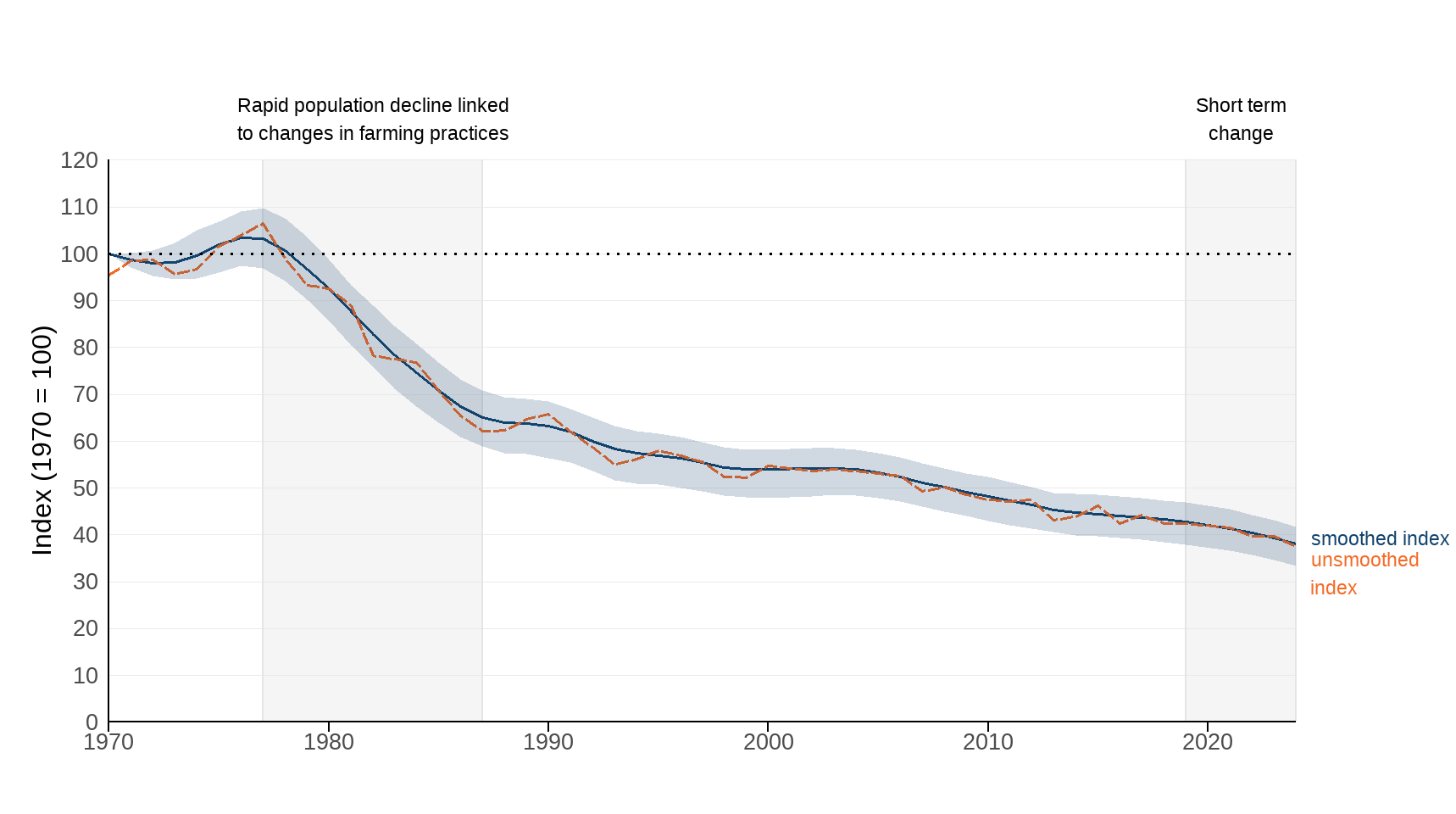
Figure 3: The index of breeding farmland bird populations for the United Kingdom, 1970 to 2024
Source: British Trust for Ornithology (BTO), Royal Society for the Protection of Birds (RSPB), and the Joint Nature Conservation Committee (JNCC)
Notes about Figure 3
- The indicators are based on the aggregated population trends of 19 species of farmland birds.
- The smoothed index is presented together with the 95% confidence interval (a measure of uncertainty) represented by the shaded area around the trend line.
- The unsmoothed index is presented as a dashed line.
The farmland bird index for the UK includes individual measures for 19 species of farmland birds, of which 12 species are farmland specialists (species that are restricted to, or highly dependent on, farmland habitats) and 7 species are farmland generalists.
Farmland bird populations have declined by 62% since 1970, with declines being stronger for farmland specialist birds than generalists. The most severe population declines occurred between the mid 1970s and the early 1990s, largely due to the negative impact of rapid changes in farmland management during this period. Although the rate of decline has slowed since this period, the populations have continued to decline at a fast rate, declining by 11% in the 5 years since 2019. The long-term decline of the farmland bird indicator in the UK has been driven mainly by the decline of farmland specialists. However, generalist species have also seen severe population declines since the mid 2000s.
Individual species trends vary, with some species populations in strong decline, some species more than doubling and other species changing very little since 1970. 63% of species have declined since 1970 and in the most recent 5 year period 42% of species have declined (see Figure 2). Examples of farmland birds in strong long-term decline include turtle dove, grey partridge, tree sparrow, corn bunting and starling.
For detailed information, including a breakdown of specialist and generalist farmland specific indices and individual species trends, see the farmland bird section in the Wild bird populations in the UK and England publication.
Woodland birds
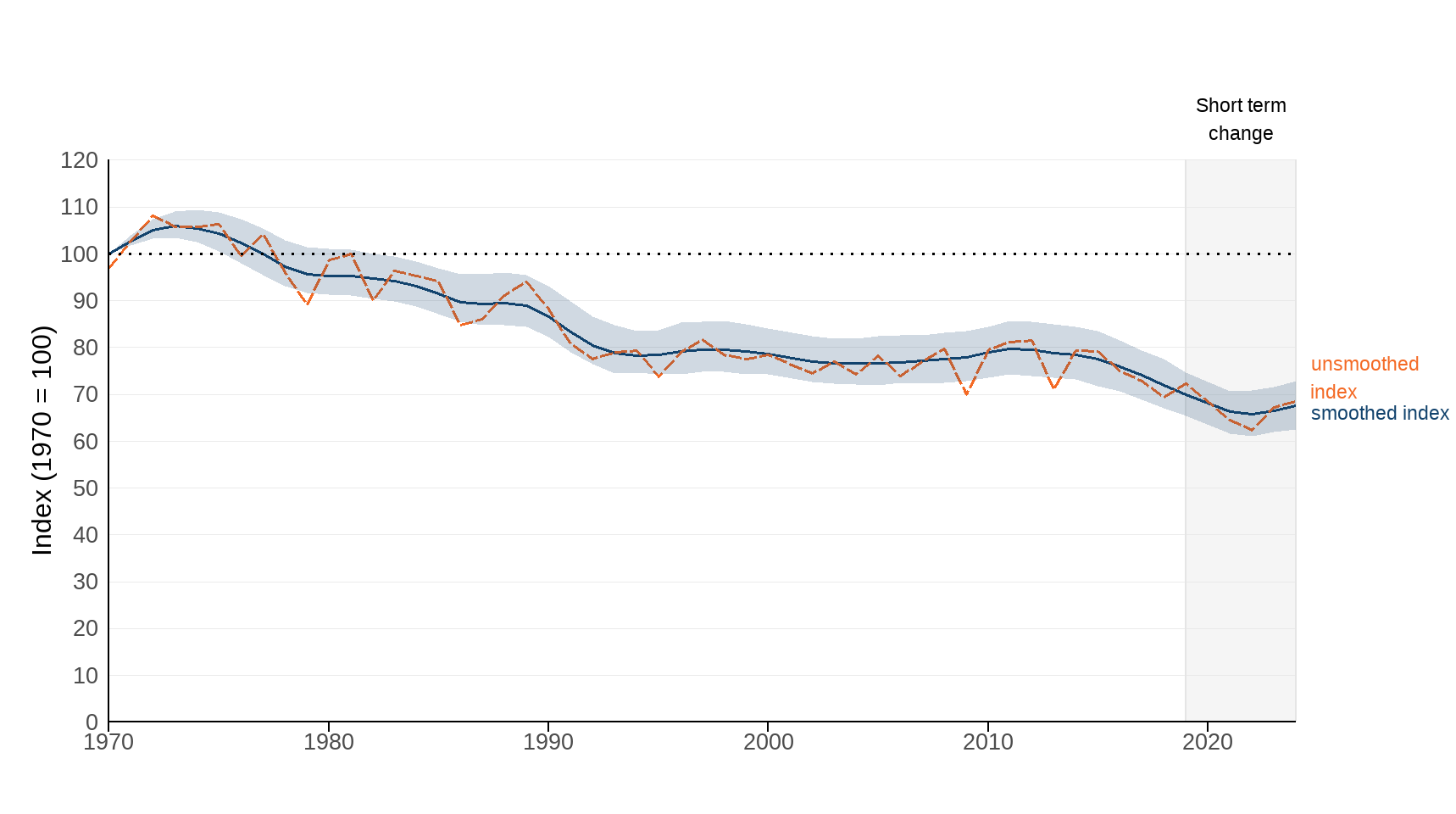
Figure 4: The index of breeding woodland bird populations for the United Kingdom, 1970 to 2024
Source: British Trust for Ornithology (BTO), Royal Society for the Protection of Birds (RSPB), and the Joint Nature Conservation Committee (JNCC)
Notes about Figure 4
- The indicators are based on the aggregated population trends of 37 species of woodland birds.
- The smoothed index is presented together with the 95% confidence interval (a measure of uncertainty) represented by the shaded area around the trend line.
- The unsmoothed index is presented as a dashed line.
The woodland bird index for the UK includes individual measures for 37 species of woodland birds, of which 25 species are woodland specialists (species that are restricted to, or highly dependent on, woodland habitats) and 12 are generalists.
Woodland bird populations have declined by 32% in the UK since 1970. The rate of decline has been relatively continuous over most of this period, but there appears to be a very recent upturn in recent years, particularly in the 2023 and 2024 breeding seasons (2024 only for the generalists), after a decade of overall decline, with the indicator showing little or no overall change in the five years since 2019. Woodland bird breeding numbers respond rapidly to good climatic conditions however, so the future trajectory is still uncertain. The long-term decline of the woodland bird indicator in the UK has been driven mainly by the decline of those species that are restricted to, or highly dependent on, woodland habitats (the ‘specialists’). The recent years of high abundance are reflected in an apparent stabilisation of the specialist indicators for the UK and England, and also for generalists in the UK.
Individual species trends vary, with some species populations in strong decline, some species more than doubling and other species changing very little since 1970. 35% of woodland species have declined since 1970 and in the most recent 5 year period 41% of woodland species have declined (see Figure 2). Examples of woodland birds in strong decline include willow tit, capercaillie, lesser spotted woodpecker and spotted flycatcher.
For detailed information, including a breakdown of specialist and generalist woodland specific indices and individual species trends, see the woodland bird section in the Wild bird populations in the UK and England publication.
Water and wetland birds
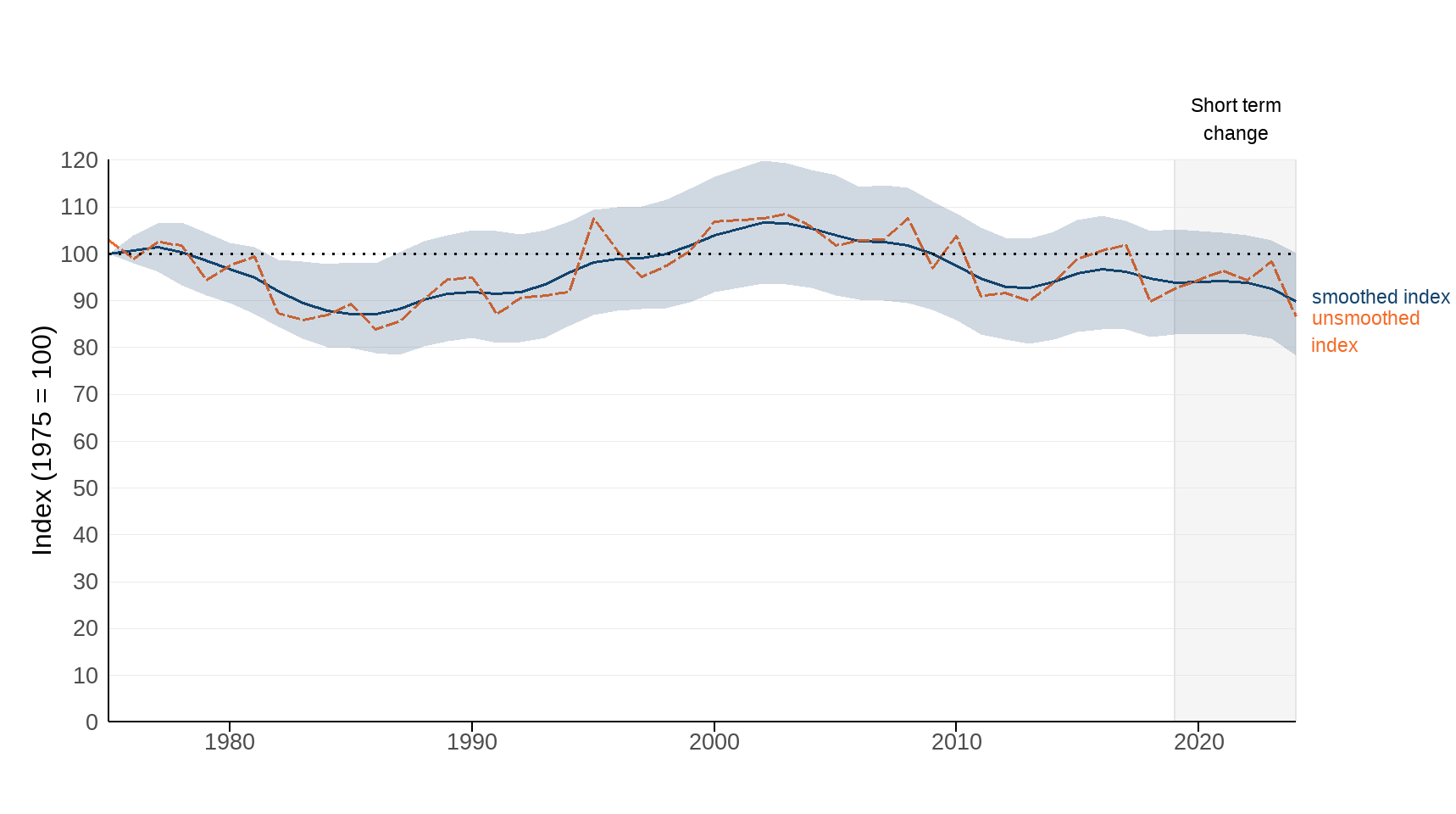
Figure 5: The index of breeding water and wetland bird populations for the United Kingdom, 1975 to 2024
Source: British Trust for Ornithology (BTO), Royal Society for the Protection of Birds (RSPB), and the Joint Nature Conservation Committee (JNCC)
Notes about Figure 5
- The indicators are based on the aggregated population trends of 26 species of breeding water and wetland birds.
- The smoothed index is presented together with the 95% confidence interval (a measure of uncertainty) represented by the shaded area around the trend line.
- The unsmoothed index is presented as a dashed line.
The UK breeding water and wetland bird index includes individual measures for 26 species. The index can be disaggregated into four sub-habitat indicators: birds of fast flowing water (4 species); birds of slow and standing water (6 species); birds of reedbeds (4 species) and birds of wet grasslands (8 species).
The breeding water and wetland bird populations have declined by 10% since 1975. However, uncertainty around this index means we cannot classify this as a meaningful change. More recently, since 2019, water and wetland bird populations have experienced declines of 4%.
Individual species trends vary, with some species populations in strong decline, some species more than doubling and other species changing very little since 1975. 27% of wetland species have declined since 1975 and in the most recent 5 year period 50% of wetland species have declined (see Figure 2). Examples of breeding water and wetland birds in strong decline include yellow wagtail in the long-term and lapwing, coot and great crested grebe in the short term.
For detailed information, including a breakdown of sub habitat specific indices and individual species trends, see the Water and wetland bird section in the Wild bird populations in the UK and England publication.
Seabirds
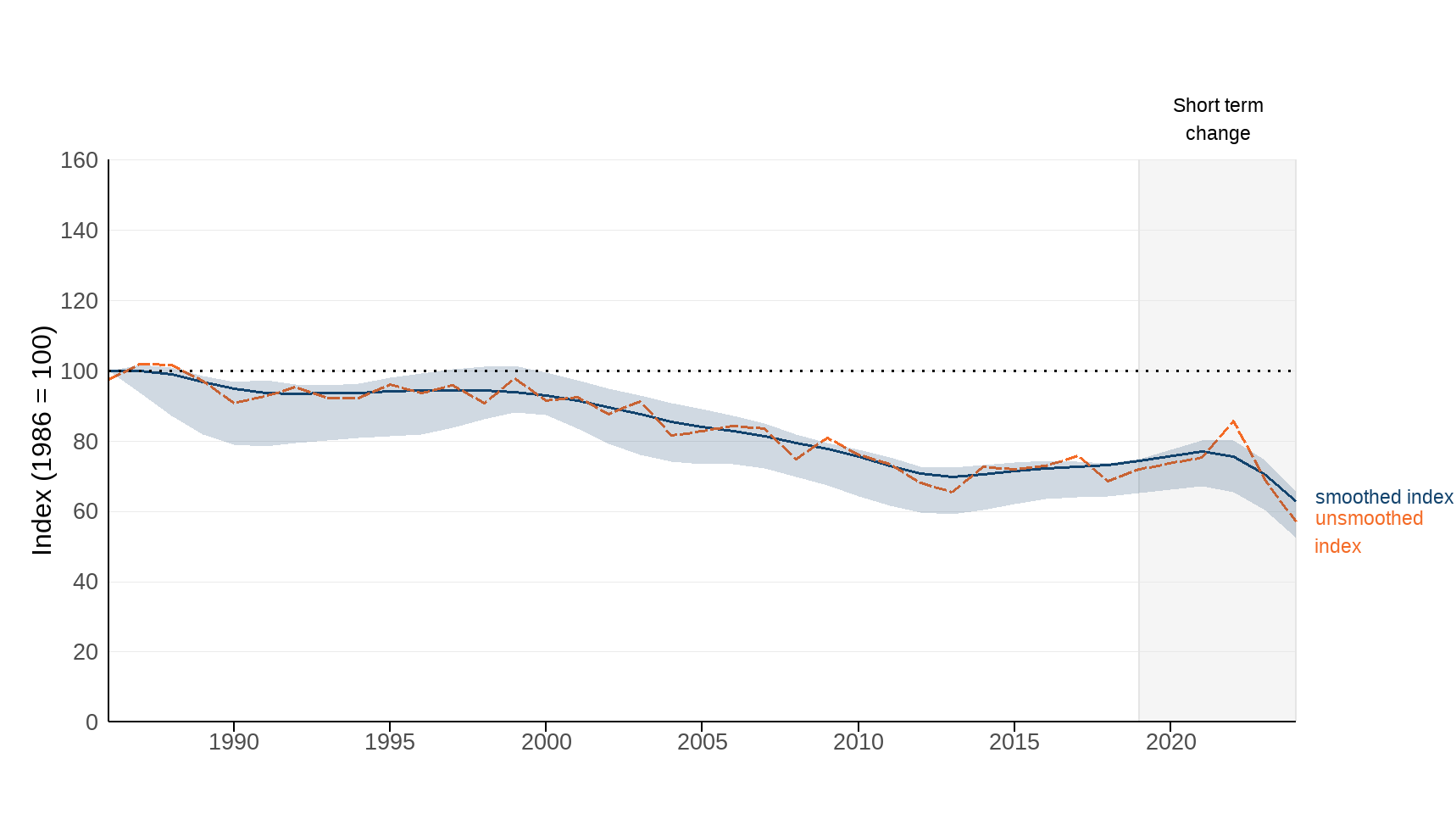
Figure 6: The index of breeding seabird populations for the United Kingdom, 1986 to 2024
Source: British Trust for Ornithology (BTO), Royal Society for the Protection of Birds (RSPB), and the Joint Nature Conservation Committee (JNCC)
Notes about Figure 6
- The indicators are based on the aggregated population trends of 13 species of seabirds.
- The smoothed index is presented together with the 95% confidence interval (a measure of uncertainty) represented by the shaded area around the trend line.
- The unsmoothed index is presented as a dashed line.
The UK breeding seabird index includes individual measures for 13 species, of which 5 species are surface feeders and 3 are subsurface feeders. Trends for the seabird indicators should be interpreted with care due to the relatively small number of species included in some indices and the scarcity of data for some constituent species.
Seabird populations have declined by 37% since 1986 and experienced little to no change in the 5 years since 2019.
Individual species trends vary, with some species populations in strong decline, some species more than doubling and other species changing very little since 1986. 38% of seabird species have declined since 1986 and in the most recent 5 year period 38% of seabird species have declined (see Figure 2). Examples of seabirds in strong decline include Arctic skua (all UK birds are in Scotland).
Data collection for seabirds was impacted by the COVID-19 pandemic but differences in annual coverage should be accounted for in the analyses. Trends in some seabird species have been negatively impacted by the onset of Highly Pathogenic Avian Influenza (HPAI) since 2020, and large annual differences in the numbers of affected birds at different colonies has added to the instability in some trends.
For detailed information, including a breakdown of sub-habitat specific indices and individual species trends, see the seabirds section in the Wild bird populations in the UK and England publication.
Upland birds
Figure 7: The index of breeding upland bird populations for the United Kingdom, 1994 to 2024

Source: British Trust for Ornithology (BTO), Royal Society for the Protection of Birds (RSPB), and the Joint Nature Conservation Committee (JNCC)
Notes about Figure 7
- The indicators are based on the aggregated population trends of 32 species of upland birds.
- The smoothed index is presented together with the 95% confidence interval (a measure of uncertainty) represented by the shaded area around the trend line.
- The unsmoothed index is presented as a dashed line.
The upland bird index for the UK includes individual measures for 32 species of upland birds, of which 13 species are upland generalists, 15 species are upland specialists (species that are restricted to, or highly dependent on, upland habitats) and 4 species are upland riparian.
Upland bird populations have declined by 11% in the UK since 1994 and have experienced little or no overall change in the 5 years since 2019, although there is some variability amongst individual groups of species.
Individual species trends vary, with some species populations in strong decline, some species more than doubling and other species changing very little since 1994. Overall, 34% of upland species have declined since 1994 and in the most recent 5 year period 42% of upland species have declined (see Figure 2). Examples of upland birds in strong decline include peregrine falcon and whinchat.
For detailed information, including a breakdown of generalist, specialist and riparian upland specific indices and individual species trends, see the upland bird section in the Wild bird populations in the UK and England publication.
Wintering waterbirds
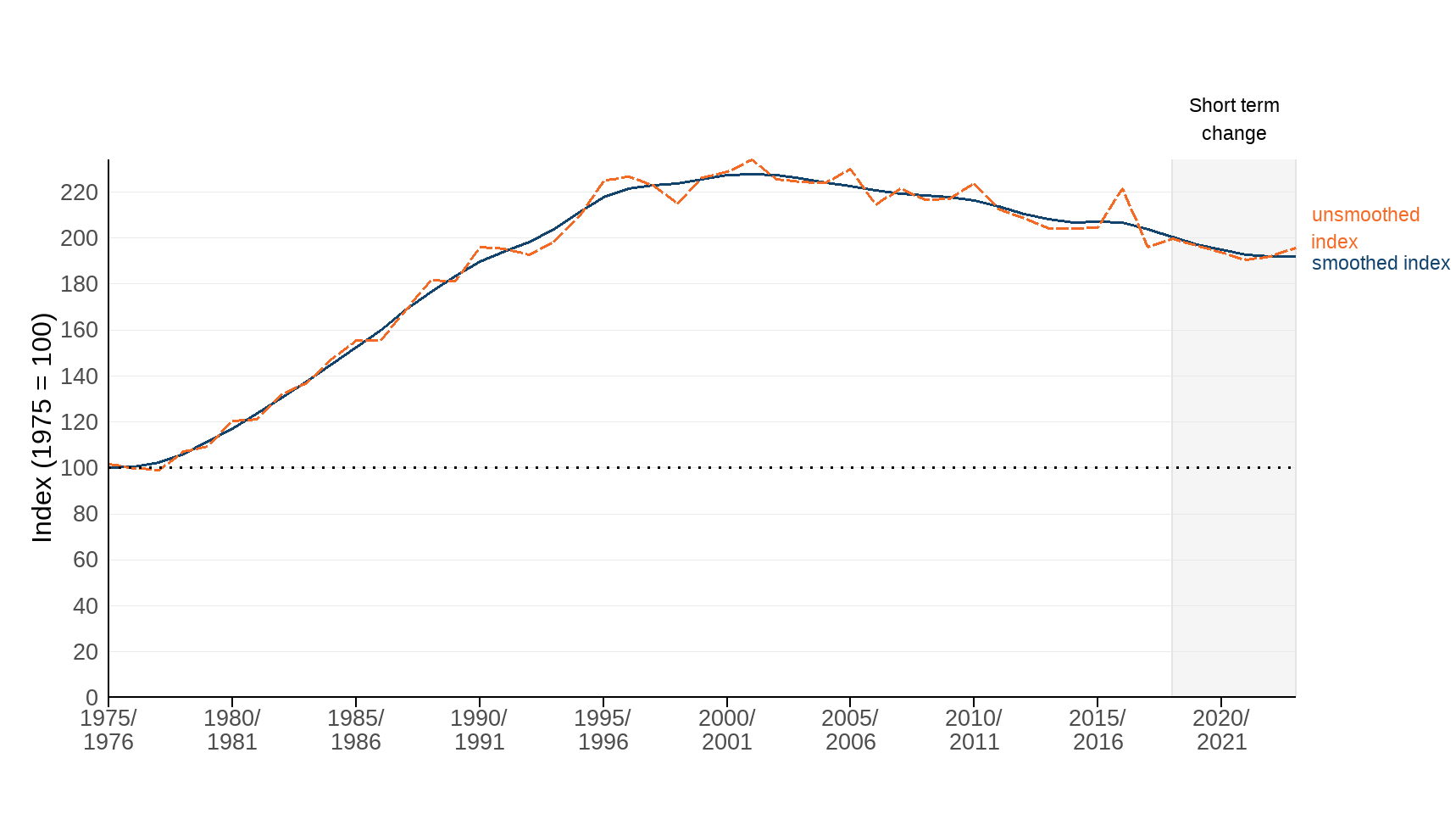
Figure 8: The index of breeding wintering waterbird populations for the United Kingdom, 1975/1976 to 2023/2024
Source: British Trust for Ornithology (BTO), Royal Society for the Protection of Birds (RSPB), and the Joint Nature Conservation Committee (JNCC)
Notes about Figure 8
- The indicators are based on the aggregated population trends of 46 species of wintering waterbirds.
- Data for wintering waterbirds are collected over the winter which spans two years e.g. 1975/1976.
- The smoothed index is presented as a solid line and the unsmoothed index is presented as a dashed line. No confidence intervals are available.
The wintering waterbird index for the UK includes individual measures for 46 species of wintering waterbirds, of which 15 species are waders and 31 species are wildfowl.
Wintering waterbird populations have increased by 92% in the UK since the winter of 1975/1976. However, since the early 2000s the index has been in decline, although this has stabilised to little or no overall change over the most recent five year period.
Individual species trends vary, with some species populations in strong decline, some species increasing tenfold and other species changing very little since 1975/1976. Overall, 50% of species have increased and 9% of species have declined since 1975/1976. However, in the most recent 5 year period 46% of species have declined (see Figure 2). No wintering water birds are in strong decline long term, but over the short term examples include Bewick’s swan, scaup and Icelandic greylag goose.
Like seabirds, wintering waterbirds have been impacted by the Highly Pathogenic Avian Influenza (HPAI) outbreak. It remains to be seen whether HPAI has longer term impacts on wintering populations of ducks, swans or geese.
For detailed information, including a breakdown of waders and wildfowl indices and individual species trends, see the wintering waterbird section in the Wild bird populations in the UK and England publication.
Further detail
The indicator has been compiled in conjunction with the British Trust for Ornithology (BTO), the Joint Nature Conservation Committee (JNCC), the Royal Society for the Protection of Birds (RSPB), and the Wildfowl and Wetlands Trust (WWT). Data are obtained from a wide range of sources, principally:
- Common Birds Census (from 1966 to 2000)
- BTO/JNCC/RSPB Breeding Bird Survey (from 1994 to 2024)
- the BTO/ Waterways Bird Survey (from 1974 to 2007)
- BTO/JNCC/RSPB Waterways Breeding Bird Survey with support from the Environment Agency (from 1998 to 2024)
- BTO/RSPB/JNCC Wetland Bird Survey counts (from 1975/1976 to 2023/24)
- BTO/JNCC/NatureScot Goose & Swan Monitoring Programme (from 1993/1994 to 2023/2024)
- Seabird Monitoring Programme (from 1986 to 2024)
- Periodic Seabird censuses supplied by JNCC, RSPB, the Seabird Group, SOTEAG (Shetland Oil Terminal Environmental Advisory Group) and other partners
- Monitoring of scarce and rare breeding birds by the Statutory Conservation Agency and RSPB Annual Breeding Bird Scheme (SCARABBS) and the Rare Breeding Birds Panel (from 1970 to 2024)
Relevance
Bird populations have long been considered to provide a good indication of the broad state of wildlife. Birds occupy a wide range of habitats and there are considerable long-term data on changes in bird populations, which help in the interpretation of shorter-term fluctuations in numbers. As they are a well-studied taxonomic group, drivers of change for birds are better understood than for other species groups, which allows for better interpretation of any observed changes. Birds also have huge cultural importance and are highly valued as a part of the UK’s natural environment by the general public.
International/domestic reporting
The suite of UK Biodiversity Indicators has been revised and updated to bring it in line with the Kunming-Montreal Global Biodiversity Framework (GBF) of the Convention on Biological Diversity (CBD). Some UKBIs will be used for the forthcoming UK national reports to CBD.
Web links for further information
Acknowledgements
Thank you to the many people from the BTO, RSPB and WWT who have contributed by providing data and to the many colleagues who have helped produce this indicator.
Technical annex
Methodology
The measures for each habitat breakdown of birds show the relative abundance of aggregated groups of species. Within the measures, each species is given equal weighting, and the annual index is the geometric mean of the individual species indices for that year. Populations of individual species within each measure may be increasing or decreasing irrespective of the overall trends. The individual species indices are largely derived by the modelling of sampled survey data, and estimates are revised when new data or improved methodologies are developed and applied retrospectively to earlier years. Further details about species and methods can be found on the British Trust for Ornithology website and by downloading the associated technical report.
A table listing the species that are included in each index can be found in the datafile. For each species, an estimate of change in the long term and in the short term is given, as well as an assessment of whether the species trend is increasing or decreasing.
The year-to-year fluctuations in each measure reflects the observed changes in the survey results, and smoothed trends, which are used with their confidence intervals to formally assess the statistical significance of change over time. Smoothed trends reduce short-term peaks and troughs resulting from, for example, year-to-year weather and sampling variations.
Data from surveys of wintering waterbirds are based on full counts on wetland and coastal sites of markedly varying size. This means the standard bootstrapping methods used to estimate confidence intervals for the farmland, woodland and wetland indices, which are based on standardised sample-based surveys, cannot be applied. Assessments of change for the waterbird index are therefore made using a ‘5% rule’. If the index has increased or decreased by greater than or equal to 5%, the index is assessed as improving or deteriorating respectively.
Composite indicators can mask a lot of variation among the species within them. The bar charts provided alongside the headline chart shows the percentage of species within that indicator that have increased, decreased or shown little change. Whether an individual bird species is defined as increasing or decreasing has been decided by its rate of annual change over the time period (long or short) of interest. If the rate of annual change would lead to a population decrease of 50% (halving), or a population increase of 100% (doubling) or more over 25 years, the species is said to have shown a ‘strong decline’ or a ‘strong increase’ respectively. Rates of change less than these but above +33% (increase) or below -25% (decrease) are labelled ‘weak’. Asymmetric thresholds are used for declines and increases to represent symmetrical proportional change in an index. These thresholds for decline are based on the rates used in the Birds of Conservation Concern status assessment for birds in the UK. Note that for most species, particularly over the longer period, the change is statistically significant.
Development plan
Future developments to be implemented over the coming years are:
- Review the species to be included in all measures and incorporate any additional species where data availability allows. This includes considering species lists for each habitat breakdown, balancing the latest available data with the consistency of the indicator.
- Review the inclusion of sub-habitat indicators and how representative they are, particularly for those with relatively low numbers of species.
- Following consultation on a review of the analytical methods used in the Seabird Monitoring Programme (SMP) species population indices, including confidence estimation, new analytical approaches will be developed and tested for the seabirds chapter. When available, the resulting trends will be incorporated into the aggregate seabird indicators.
- Consider alternative methods for assessing change at the species level. This includes considering the time period over which long and short term assessments are carried out, as well as the current Birds of Conservation Concern thresholds for individual species trends.
References
-
Fewster, R. M., Buckland, S. T., Siriwardena, G. M., Baillie, S. R. and Wilson, J. D. (2000). Analysis of population trends for farmland birds using generalized additive models. Ecology, 81, pp. 1970 to 1984.
-
Freeman, S.N., Noble, D.G., Newson, S.E. and Bailie, S.R. (2003) Modelling bird population changes using data from the Common Bird Census and the Breeding Bird Survey. BTO research report no. 303. BTO, Thetford.
-
Gregory, R.D., Gibbons, D.W., Impey, A. and Marchant, J.D. (1999) Generation of the Headline Indicator of Wild Bird Populations. BTO research report 221. BTO and RSPB, Thetford.
-
Harris, S.J., Massimino, D., Gillings, S., Eaton, M.A., Noble, D.G., Balmer, D.E., Procter, D. and Pearce-Higgins, J.W. and Woodcock, P. (2018). The Breeding Bird Survey 2017. BTO Research Report 706. BTO, Thetford.
-
Noble, D.G., Newson, S.E., Banks, A. and Gregory, R.D. (2003a) Effect of transition from CBC to BBS on Wild Bird Indicators. BTO and RSPB report to Defra.
-
Noble, D.G., Newson, S.E. and Gregory, R.D. (2003b) Production of the 2002 Farmland PSA indicators. BTO and RSPB report to Defra.
-
Noble, D.G., Newson, S.E. and Gregory, R.D. (2004) Approaches to dealing with disappearing and invasive species in the UK’s indicators of wild bird populations. BTO and RSPB report to Defra.
-
Renwick, A.R., Johnston, A., Joys, A., Newsom, S.E., Noble, D.G. and Pearce-Higgins, J.W. (2012) Composite bird indicators robust to variation in species section and habitat specificity. Ecological Indicators, 18, 200–207.
-
Tremlett, C.J., Morley, N., and Wilson, L.J. (2024). UK seabird colony counts in 2023 following the 2021-22 outbreak of Highly Pathogenic Avian Influenza. RSPB Research Report 76. RSPB Centre for Conservation Science, RSPB, The Lodge, Sandy, Bedfordshire, SG19 2DL. ISBN: 978-1-905601-72-1
-
Underhill, L.G. and Prŷs-Jones, R. (1994) Index numbers for waterbird populations. I. Review and methodology. Journal of Applied Ecology, 31, 463–480.
-
Woodward, I.D., Massimino, D., Hammond, M.J., Harris, S.J., Leech, D.I., Noble, D.G., Walker, R.H.,Barimore, C., Dadam, D.,Eglington, S.M., Marchant, J.H., Sullivan, M.J.P., Baillie, S.R. and Robinson, R.A. (2018). BirdTrends 2018: trends in numbers, breeding success and survival for UK breeding birds. Research Report 708. BTO, Thetford.
Categories:
Published: