
Indicator development plan
Development plan
These developments apply to the UK and England biodiversity indicator suites as a whole. For individual development plans, see the specific ‘Development plan’ section in each indicator. This particularly applies to Official Statistics in Development, which describe more detail of planned developments and timings.
Planned developments for the indicator suites for the coming years:
-
Further develop indicators to support the UK’s reporting requirements for the Kunming-Montreal Global Biodiversity Framework. This may include some indicators for which a methodology has not yet been finalised.
-
Continue to adapt and develop indicators to better align with Defra’s Environment Improvement Plan.
-
Following the discontinuation of several of the England biodiversity indicators, review any feedback provided by users.
-
Explore options to improve the user experience and navigation, including new categorisations of indicators such as habitats and species.
Indicator reviews
The UK and England biodiversity indicators have undergone several review periods, including our most recent review period in 2025. You can find details of each review below.
Indicator prioritisation exercise (2025)
Background
Following the 15th meeting of the parties to the Convention on Biological Diversity (CBD), where the UK became a signatory to the Kunming-Montreal Global Biodiversity Framework (GBF), the Joint Nature Conservation Committee (JNCC) working alongside Defra and with the devolved governments and Statutory Nature Conservation Bodies, reviewed the GBF headline indicators against the current suite of UK and England Biodiversity Indicators. The report summarising this work is available on the JNCC website.
As a consequence of this work, a number of new indicators were developed in 2025 to report to CBD, and several existing indicators were adapted. Many of these have been published as part of the UK Biodiversity Indicators compendium, substantially adding to the size of the suite. Consequently, there was a need to review the coherence of the suite and its relevance for users.
User engagement and indicator review
The Biodiversity Indicators statistics team ran a user engagement exercise to update their understanding of how the existing indicators were used and by who. This exercise helped ensure that the suite of indicators that we produce remain relevant, useful and high quality.
The steps undertaken included:
- running a user survey to refresh our understanding of how each indicator is used
- engaging directly with known users and stakeholders to gather feedback on the usefulness and quality
- an internal scoring exercise against standardised criteria, which included: data quality, value to users, uniqueness of data and production efficiency
- engaging with the Biodiversity Indicators Steering Group for advice
A wide variety of uses of the data published within the indicator suites were identified. Many of the indicators are used for formal reporting within and outside government. For instance, several indicators feed into Defra’s Environmental Indicator Framework, which relates to the 10 goals within the Environmental Improvement Plan and informs Defra’s Annual Progress Report for the Environment Improvement Plan. Some indicators form the basis of the UKs Sustainable Development Goals indicators, others are used by the Office for National Statistics (ONS) in the ONS Natural Capital Accounts and ONS Measures of National Well-being Dashboard. Many indicators are used in the State of Nature reports which are produced by a consortium of organisations, as well as other reports produced outside of government. Beyond formal reporting purposes, the indicators are frequently used to provide background information or wider context to other work, or to benchmark more disaggregated data to the national picture.
One of the key criteria assessed by the Biodiversity Indicators statistics team was the uniqueness of the data published within the indicator suites. Several of the existing indicators reproduce data which are openly available elsewhere, while others draw together data from open sources. Whilst there is value in bringing data together in this way (for instance, drawing together country level data to construct a UK level picture), the impact on users of discontinuing these indicators would be less than discontinuing those which do not draw on open data.
Based on the information from the user survey, engaging with known stakeholders and the scoring exercise the following indicators have been identified as candidates for discontinuation:
- Status of threatened habitats: habitats of European importance (UK and England)
- Status of threatened species: species of European importance (UK and England)
- Habitat connectivity – Functional connectivity of species (UK)
- Integration of biodiversity considerations into business activity (UK)
- Fish size classes in the North Sea (UK)
- Sustainable fisheries: fish stocks harvested within safe limits (UK)
- Awareness, understanding and support for conservation (UK and England)
- Taking action for the environment: Households encouraging wildlife in their garden (England)
- Area of forestry land certified as sustainably managed (UK and England)
- Removal of greenhouse gases by forests (UK and England)
- Surface water status (UK and England)
These indicators were chosen as they are either published elsewhere, are compiled from data published elsewhere, or had lower importance scores from the user survey than others in the suite. The two indicators of status of habitats and species of European importance did score highly in the user survey, but comments from respondents suggested that it was the underlying data which was important, rather than these indicators. The data underpinning these indicators, which is produced for Habitat Regulations reporting, is freely available elsewhere.
Some indicators have been identified as in scope for reducing the frequency of updates to less than annual:
- Taking action for nature: volunteer time spent in conservation (UK and England)
- Extent and condition of priority habitats (England)
- Animal genetic resources – effective population size of Native Breeds at Risk (UK)
- Plant genetic resources – Enrichment Index (UK)
- Air Pollution: Area affected by acidity and area affected by nitrogen (UK and England)
- Pressure from invasive species (UK)
- Marine pollution (UK)
These indicators are not used for formal reporting purposes, as far as we are aware, and they tend to show little annual change or the data may not updated regularly.
Some existing indicators in the UK Biodiversity Indicators compendium have been further developed to include new data for reporting to CBD, and will be updated regularly with new data:
- Coverage of protected areas and other effective area-based conservation measures (incorporated into our existing Extent and condition of protected sites indicator) (GBF Headline indicator 3.1)
- Rate of invasive alien species establishment (will be incorporated into our existing pressure from invasive species indicator) (GBF Headline indicator 6.1)
- Indicator on biodiversity information for monitoring the global biodiversity framework (replaces our existing biodiversity data for decision making indicator) (GBF Headline indicator 21.1)
- International public funding, including official development assistance (ODA), for conservation and sustainable use of biodiversity, and ecosystems (will be incorporated into our existing biodiversity funding indicator) (GBF Headline indicator D.1)
- Private funding (domestic and international) on conservation and sustainable use of biodiversity and ecosystems (will be incorporated into our existing biodiversity funding indicator) (GBF Headline indicator D.3)
A further nine new indicators, developed for reporting to CBD, have been introduced to the UK Biodiversity Indicators compendium in 2025:
- Services provided by ecosystems (GBF Headline indicator B.1)
- Average share of the built-up area of cities that is green/blue space for public use for all (GBF Headline indicator 12.1)
- Number of companies disclosing their biodiversity-related risks, dependencies, and impacts (GBF Headline indicator 15.1)
- Positive incentives in place to promote biodiversity conservation and sustainable use (GBF Headline indicator 18.1)
- Value of subsidies and other incentives harmful to biodiversity (GBF Headline indicator 18.2)
- Aggregated Total Applied Toxicity (ATAT) (GBF Headline indicator 7.2)
- Red List of Ecosystems (GBF Headline indicator A.1)
- Extent of natural ecosystems (GBF Headline indicator A.2)
- The proportion of populations within species with an effective population size > 500 (GBF Headline indicator A.4)
These indicators (except for Services provided by ecosystems) will next be updated with new data in 2028. These indicators generally are either in need of further development, show little annual change or the data may not update regularly or are of less relevance to users other than for international comparisons. We will aim to update Services provided by ecosystems with new data annually.
User survey findings
During 2025, the Biodiversity Indicators statistics team conducted a user survey of the UK and England indicator compendiums. The survey ran from February to May 2025 with 76 respondents.
The survey revealed that the England and UK Biodiversity Indicators have a wide range of users, predominantly from the civil service and environmental charity sectors, but also from academia, local government and the private sector.
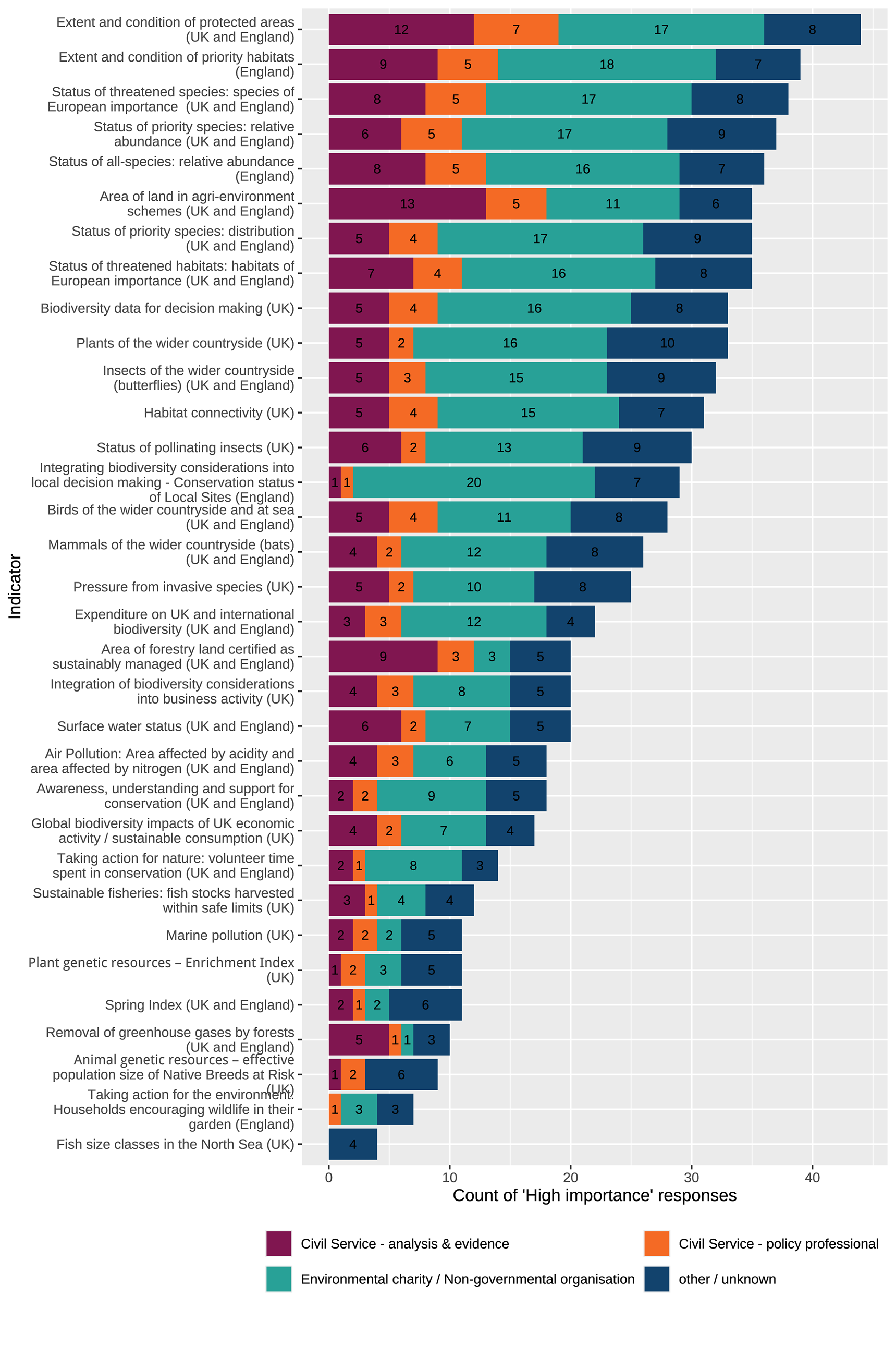
Respondents were asked to rate how important each indicator was for their work. All of the indicators were rated ‘highly important’ by at least one respondent. Figure 1 shows the distribution of importance scores for each indicator. Indicators which focus on the state of species or habitats tended to be rated most highly. Marine indicators tended to be rated lower, possibly because there are other sources of indicators of the marine realm which are more expansive such as the UK Marine Strategy and OSPAR.
Figure 1. The distribution of importance scores across the indicators in the England and UK Biodiversity Indicator suites.

The survey also revealed that each indicator was important for a variety of users. Figure 2 shows which user group rated each indicator as highly important for their work. The distribution of users is relatively consistent across the indicators, most being from the civil service or environmental charity background.
Figure 2. The type of respondents who rated the indicators ‘highly important’.
Indicator review (2022)
During 2022, the Biodiversity Indicators production team conducted a review of the UK and England indicator suites. The indicators were each developed at different times, by different teams of experts and have continued to evolve in different ways over time. As such some inconsistencies existed, and it was necessary to review each indicator’s adherence to the Code of Practice for Statistics and the 3 pillars of Trustworthiness, Value and Quality.
Each indicator was reviewed against the Code of Practice for Statistics and the statistical methods used were reviewed to check for consistency and suitability. The findings from these reviews informed the development plans for each indicator, which have been implemented since then. In addition to indicator-specific plans, this included; reviewing and updating desk instructions, developing Reproducible Analytical Pipelines (RAP) workflows, improved commentary and a review of the assessment methods applied across the indicators.
Species Indicator Review (2016)
In 2015-16, Defra commissioned a Quality Assurance Panel to provide advice on improvements that could be considered to the species-based indicators in the UK and England biodiversity indicator sets. The membership of the Panel was:
- Professor Ken Norris, Institute of Zoology (Panel Chair)
- Professor Stephen Buckland, University of St Andrews
- Professor Rhys Green, University of Cambridge
- Professor Helen Roy, Centre for Ecology & Hydrology
- Dr Phil Stephens, University of Durham
A structured review process was used to critically examine each indicator and to produce suggestions for improvements in each. Each structured review was led by one expert but discussed by all panel members to ensure a consistent approach. Following these reviews, a synthesis of the general issues that emerged from the reviews within a good practice framework was prepared, with some suggestions about improvements that may be made.
The Science Panel review produced a large number of recommendations (57) which were considered by the Biodiversity Indicator Steering Group (BISG); focusing on those issues that potentially limit the use of the indicators by making trends unreliable or open to misinterpretation. The consideration of the recommendations made by the Panel led to an action plan of changes to be made as resources allowed.
The report is available on the Defra Science Search website. In response, an action plan was agreed with the Biodiversity Indicators Steering Group, and is available to download on the JNCC website.
Additionally a series of Evidence Statements to accompany each of the species indicators was published in 2016.
Categories:
Published: